Recognizing Spiritual Potential in a Horoscope
In Vedic astrology, spirituality and the inclination toward higher knowledge or renunciation can often be seen in the natal chart through planetary placements, house lordships, and their interactions. While everyone has a potential for spiritual growth, certain combinations make it more natural or likely.
Key Planets and Their Spiritual Significance
Jupiter and Ketu are gyanakaraka planets, givers of divine wisdom.
- Jupiter (Guru)
- The primary indicator of wisdom, dharma, and spiritual understanding.
- When placed in moksha houses the 4th, 8th, or 12th, it can strengthen the native’s quest for liberation.
- Aspect or conjunctions with Ketu or Saturn can further intensify spiritual tendencies.
- Ketu (South Node of the Moon)
- The karmic planet of detachment, past-life learning, and renunciation.
- Strong Ketu, especially in moksha houses, can create natural disinterest in material pleasures, pushing one toward inner work.
- Sh K. N Rao always recommends Ketu aspected by Jupiter in such cases.
- Saturn (Shani)
- Represents detachment, discipline, and hard lessons in life.
- Although often associated with obstacles, it can cultivate vairagya, or the willingness to let go of worldly attachments.
- Saturn’s placement and aspects to the Moon or personal planets can create conditions where spiritual focus emerges through life’s challenges.
Important Houses for Spirituality
The Houses of Moksha are also houses for spiritual and occult powers. i.e 4,8 and 12.
- Moksha Trikonas: 4th, 8th, and 12th houses.
- Planets here, especially Jupiter and Ketu, favor contemplation, meditation, and detachment.
- Water signs (Cancer, Scorpio, Pisces) in these houses, particularly when occupied by spiritual planets, often indicate a natural depth of feeling and intuition- fertile ground for spiritual practice.
- Moon:
- Moon represents the mind. Its placement is critical for meditation, emotional control, and spiritual focus.
- Special combinations:
- Moon in a house ruled by Mars, aspected by Saturn.
- Moon in a house ruled by Saturn, aspected by Mars.
These combinations, in either the D1 or D9 charts, can create mental discipline, resilience, and spiritual sensitivity.
Special Yogas and Patterns for Spiritual Growth
Planets in sarpa dreshkonas and their dashas can also ignite a strong spiritual drive.
Sarpa Dreshkonas are situated in watery signs cancer, scorpio and pisces.
The planet’s dasha during which it transits these dreshkonas can activate spiritual or renunciatory tendencies.
These placements confer with detachment, introspection, and karmic learning, not necessarily immediate renunciation but a lifelong inclination toward spirituality.
Sanyasa Yoga
Formed when four or more planets occupy a single house, including the 10th lord, and none are combust.
Indicates potential for renunciation, monastic tendencies, or intense spiritual life.
D20 or vimshamsa is the divisional chart to check spiritual tendancies in a horoscope for further details.
A Jain Monk’s Horoscope: Spiritual Power Seen Through Jyotisha
In Jain tradition, monkhood is not symbolic. It is absolute renunciation, often chosen very early in life (13–20 years), only after parental consent and rigorous testing by senior monks. Such renunciation is rare and usually supported by unmistakable karmic indicators in the horoscope.
One such monk was Shastri Muni Maharaj, widely revered in North India. He lived as a true yogi, surrounded by seekers, consulted for guidance and predictions, and known for intuitive and psychic abilities. Please see his natal chart below
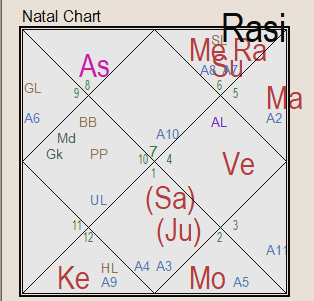
The chart above is his with tula lagna. I don’t have the exact time to present full details.
During personal interactions, he shared charts of other Jain monks for analysis and eventually revealed his own horoscope. Although the exact birth time is no longer available, two combinations stood out clearly and he pointed these to me. Mercury Sun Rahu combination in the twelfth house. Mercury is the exalted twelfth and ninth lord and is in the twelfth house. There is also an exchange between 10th and 8th lords with both being benefic. Also, his Moon the tenth lord exalts in the eighth house, giving him access to realms and psychic powers.
1. Exchange Between 10th and 8th Lords (Karma–Moksha Axis)
A 10th–8th lord exchange is highly significant in spiritual horoscopes.
- The 10th house represents karma, action, public role.
- The 8th house represents transformation, occult knowledge, death of ego, and deep tapasya.
When these lords exchange signs:
- Worldly karma becomes a vehicle for inner transformation.
- Public life dissolves into spiritual purpose.
- Action is no longer for status, but for transcendence.
In monastic charts, this exchange often shows:
- Early withdrawal from material profession.
- A life devoted to guiding others spiritually.
- Comfort with secrecy, silence, and ascetic discipline.
This aligns perfectly with Jain monkhood, where one abandons all social identity yet becomes a karmic reference point for others.
2. Saturn–Jupiter Conjunction in the 7th House
A Saturn–Jupiter conjunction is rare and powerful, especially for spiritual authority. Both planets are retrograde.
- Jupiter: wisdom, shastra, guidance, grace.
- Saturn: austerity, discipline, renunciation, tapasya.
Their conjunction produces Jnana through Tapas.
Placed in the 7th house:
- The monk becomes a mirror for others.
- People are naturally drawn to seek guidance.
- Spiritual energy is transmitted through dialogue, presence, and gaze.
This placement does not indicate marriage in ascetic charts. Instead, it shows:
- One-to-one spiritual influence.
- The ability to read others’ karmas.
- Authority acknowledged without force.
Many yogis with psychic perception have this exact combination, especially when unafflicted and supported by moksha houses.
Unfortunately, my private sessions with him were short-lived, as he passed away in April 2016. Interestingly, I was myself running Saturn–Ketu dasha at that time. He told me not to give up astrology. He encouraged me to keep practicing it. These words have guided my journey ever since.

 Predictions By Sid
Leave a comment