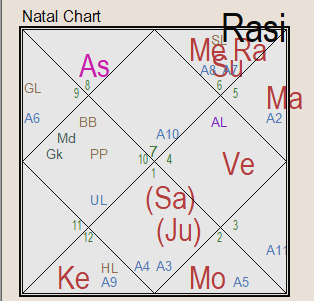
To believe in Jyotisha, one has to believe in reincarnation.
That is not a slogan. It is the foundation. A birth chart is a map of the sky at the moment a soul arrives. If this life were the first and only one, that map would be random, a coincidence of planets and minutes. Jyotisha makes sense only if the soul comes in carrying something: a history, unfinished work, a reason for being born to these parents, in this place, at this time.
So where do we look for signs of a soul that travels from life to life? Some of the most moving accounts come from two very different groups of people: those who nearly left this life and came back, and young children who seem to remember a life before this one.
Contents
- What people describe
- The life review: watching your own film
- The soul always has a choice
- Children who remember: the work of Ian Stevenson
- Shanti Devi: one soul, two lives
- Samskaras: what the soul carries
- Edgar Cayce and the soul’s long history
- The Akashic records
- Karma: why this life, and not another
- Where Jyotisha fits
- What this means for you
What people describe
The phrase “near-death experience” became widely known through Dr. Raymond Moody’s book Life After Life in 1975. In the decades since, people across countries, religions and age groups have described something remarkably similar when their heart stopped, or when they came close to dying in an accident, an illness or on an operating table.
They speak of leaving the body and watching the scene from above: the doctors, the family, the room. Of a tunnel, or a light that feels like love rather than brightness. Of meeting relatives who had already passed, sometimes relatives they had never known about. Of a deep peace, and a sense of being home.
And then, again and again, the same moment: being told, or choosing, to come back.
“It is not your time.” “You still have work to do.” “Your children need you.” The words differ from story to story. The meaning does not. Something, or someone, makes it clear that this life is not finished.
The life review: watching your own film
One of the most striking parts of many NDEs is the life review. People describe their whole life passing before them, often like a film. But it is not the film they lived. It is the same story seen from other angles.
They see a moment of anger from the side of the person who received it, and feel what that person felt. They see a small kindness they had long forgotten, and feel the ripple it created in someone else’s life. Many say there was no judge in the room. They judged themselves, because for the first time they could see the whole picture.
Many say there was no judge in the room. They judged themselves.
This is a powerful idea. It suggests that every action is recorded, not only what we did, but what it meant to others. Nothing is lost. And the purpose of seeing it is not punishment. It is understanding, so the soul can carry the lesson forward.
Anyone who has studied karma will recognise this immediately.
The soul always has a choice
Another thread runs through these accounts. Many people say they were given a choice. They could stay in that peace, or they could return to a body that was injured or sick, to pain and responsibility. Many say they did not want to come back. They chose to, out of love for someone, or because they understood there was something left to do.
This matches a teaching found across spiritual traditions: the soul is never a prisoner. It agrees to its journey. It chooses its parents, its circumstances, its lessons. Life may feel imposed on us, but at the deepest level, the soul said yes to it.
That changes how we see hardship. A difficult childhood, a long illness, a broken relationship: these may be chapters the soul accepted because they carried something it needed to learn or repay. And at every stage, the soul keeps choosing. How we respond to what comes is always ours.
Children who remember: the work of Ian Stevenson
If NDEs show the soul stepping out of the body and returning, another body of research points to the soul arriving with memories of a previous body.
Dr. Ian Stevenson was a psychiatrist at the University of Virginia. For around forty years he travelled to India, Sri Lanka, Lebanon, Turkey, Burma, Alaska and elsewhere to investigate young children who spoke spontaneously about a past life. His approach was careful and sceptical. He interviewed families, tracked down the people and places the children described, and checked the details against records. His first major book on the subject, Twenty Cases Suggestive of Reincarnation, appeared in 1966, and over his career he gathered thousands of cases.
The patterns he found were consistent. The children usually began speaking about the previous life between the ages of two and five, and the memories tended to fade by about seven. Many described names, towns, family members and the way they had died. In a number of cases the previous person had died suddenly or violently. Stevenson also documented birthmarks and birth defects that corresponded to wounds on the body of the person the child claimed to have been.
Stevenson never claimed he had proved reincarnation. He said his cases were “suggestive” of it, and that reincarnation was the best explanation for some of them. That honesty is part of what makes his work so hard to dismiss. His research continues today at the University of Virginia.
Shanti Devi: one soul, two lives
Among the best-known cases from India is that of Shanti Devi, born in Delhi in 1926.
As a little girl of about four, she began telling her parents that her real home was in Mathura, that she had a husband there, and that she had died after giving birth to a son. At first her family dismissed it as a child’s imagination. But she kept insisting, and she gave details.
Eventually her account was checked. A man in Mathura matching her description did exist, and his wife, Lugdi Devi, had died shortly after childbirth in 1925, about a year before Shanti Devi was born. When Shanti Devi was taken to Mathura, she is reported to have recognised members of that family and found her way around the town. Her case drew so much attention that a committee of prominent people was formed in the 1930s to investigate it, and Mahatma Gandhi took an interest in it. She spoke about her memories for the rest of her life and passed away in 1987.
For an astrologer, this case offers something rare. Shanti Devi knew Shri K.N. Rao personally and used to visit him in Delhi to discuss astrology. In his lectures in the United States between 1993 and 1995, which can still be found on YouTube, he discussed both of her horoscopes. He had obtained the horoscope of her previous life as Lugdi Devi and corrected it, so that he could study it alongside her chart in this life, the life in which she remembered. The question is simple: if the soul carries its karma from one birth to the next, does the sky reflect that continuity?
He shared one more detail that stays with me. Shanti Devi told him that in this life she never wanted to have a child. In her last life, childbirth was what took her. The fear had travelled with her.
The fear had travelled with her.
Samskaras: what the soul carries
In the Indian tradition, this is what we call a samskara: an impression left on the mind by a deep experience. Most of the time these impressions sink below awareness, but they do not disappear. They travel with the soul into the next birth and shape its likes, fears, talents and habits. When a samskara settles into a lasting tendency, it is called a vasana.
The clearest source for this is Patanjali’s Yoga Sutras, written some two thousand years ago.
- Yoga Sutra 2.12 says that the store of karma, rooted in our afflictions, is experienced “in the seen and the unseen births”, that is, in this life and in lives to come.
- Yoga Sutra 4.9 says that even when lives are separated by birth, place and time, there is continuity, because memory and samskaras are of one form. The impression survives the gap between bodies.
- Yoga Sutra 3.18 says that by directly perceiving one’s samskaras, one gains knowledge of previous births.
- Yoga Sutra 2.9 describes abhinivesha, the clinging to life and fear of death, as something that flows by its own nature and is present even in the wise. Commentators have long explained it as a memory of having died before.
Shanti Devi’s fear of having a child is exactly this: a samskara from one life showing up in the next. Stevenson noticed the same pattern in his cases. Children who remembered a past life often had a fear connected to how they had died, of water, of vehicles, of a particular weapon.
Studies like this are what Jyotisha is truly for. Not fortune telling, but understanding how a soul’s story continues across lives.
Edgar Cayce and the soul’s long history
Across the world, a very different man came to similar conclusions.
Edgar Cayce (1877 to 1945) was an American, raised as a devout Christian, who became known as “the Sleeping Prophet”. In a trance-like state he gave thousands of readings, most of them for people seeking help with health problems. Over time, his readings began to speak of something he had not been looking for: past lives.
In what came to be called “life readings”, Cayce described the previous incarnations of the people who came to him, and linked their present talents, fears, relationships and illnesses to things that had happened in earlier lives. Cayce himself was troubled by this at first, because reincarnation did not fit his upbringing. He came to accept it because the readings kept returning to it, and because they seemed to help people.
His readings are kept today by the Association for Research and Enlightenment in Virginia Beach, which he founded.
The Akashic records
Cayce said that his information came from what he called the Akashic records, sometimes described as “the Book of Life”.
The word comes from Sanskrit. Akasha is space or ether, the subtlest of the five elements in Indian thought, the field in which everything else exists. The idea of the Akashic records, as it spread in the West in the late nineteenth and twentieth centuries, is that every thought, word and action of every soul leaves an impression in this subtle field. Nothing is ever truly erased.
Whether one takes this literally or as a metaphor, it fits closely with what NDE survivors report in their life reviews: a complete record, seen from every angle. And it fits with the Indian understanding of karma, where every action leaves a trace that will one day come back to us.
Karma: why this life, and not another
If the soul comes back, why does it come back to this life?
The tradition answers with karma. Over many lifetimes, the soul builds up a vast store of actions and their results. Only a portion of that is given to be lived out in any one birth. Some of it waits for later. And what we do now, by our own free will, plants seeds for what comes next.
Seen this way, a near-death experience is a pause in the middle of the story. The soul steps out, sees the bigger picture, and is returned because the portion of karma meant for this life is not yet complete. It also explains why so many survivors feel they came back for something. They usually do.
In the Bhagavad Gita (2.22), Krishna tells Arjuna that just as a person throws away worn-out clothes and puts on new ones, the soul throws away worn-out bodies and enters new ones. Death, in this view, is a change of clothes. The one wearing them continues.
Death is a change of clothes. The one wearing them continues.
Where Jyotisha fits
Put these pieces together. A soul that survives the body. A record of everything it has done. A choice to return. Children who arrive remembering. If all of this is true, then the moment of birth is not an accident. It is a signature, the moment a particular soul, with a particular history, steps back into the world.
Jyotisha is the discipline of reading that signature.
A chart does not prove that a soul exists. It assumes it. It shows what this soul has brought into this life: its gifts, its debts, its relationships, its turning points, and the periods when life will push it to grow. The planets do not cause our karma. They mark its timing, the way a clock does not cause the morning but tells us when it has come.
This is also why a careful astrologer never predicts death. The tradition is clear that the length of a life is not something to announce. What a chart can show is when a person goes through a sensitive phase, a time to take care, slow down, get checked and turn inward. Many people who have had an NDE describe exactly that: a crisis that became the turning point of their life.
What this means for you
You do not need to have died and come back to take something from these stories.
- Your life has a purpose. Those who returned were told they had work left. So do you.
- You always have a choice. The circumstances may be given, but how you meet them is yours.
- Every action counts. If life is reviewed from every angle, kindness matters more than we think.
- Hard phases end. Even the deepest crisis is a chapter, not the whole book.
- Fear can soften. Those who came closest to death are often the least afraid of it.
Jyotisha, at its best, does not frighten. It reminds us that we are souls on a long journey, that this birth was chosen with care, and that every phase of life, including the hardest, has a reason and an end.
Sid, Predictions by Sid