Every Jyotisha student hears early on that the navamsa (D9, the ninth divisional chart) is the most important chart after the rashi chart. It is read for marriage, for dharma, and for the real strength of every planet. A planet that looks strong in the rashi chart but falls weak in the navamsa often fails to deliver. The old saying puts it simply: the rashi is the tree, the navamsa is the fruit.
Most of us let software draw the navamsa. But the calculation is simple, and once you see it, you will understand why a few minutes of birth time can change a chart, and why some planets are called vargottama.
Step 1: Cut each sign into nine parts
Nava means nine and amsha means part. Each sign of 30° is divided into nine equal parts:
30° ÷ 9 = 3°20′ (three degrees and twenty minutes)
In minutes of arc, that is 1,800′ ÷ 9 = 200′ per navamsa.
So the zodiac has 12 × 9 = 108 navamsas. This number is not an accident. The zodiac also has 27 nakshatras of four padas (quarters) each, and 27 × 4 = 108. Each navamsa is exactly one nakshatra pada. When software tells you the Moon is in Krittika pada 4, it has already told you the Moon’s navamsa.
Step 2: Find where the count starts
This is the only rule to learn. The count of nine does not start from the same sign every time. It depends on the element of the sign:
Sign group
Signs
Count starts from
Fire
Aries, Leo, Sagittarius
1, Aries
Earth
Taurus, Virgo, Capricorn
10, Capricorn
Air
Gemini, Libra, Aquarius
7, Libra
Water
Cancer, Scorpio, Pisces
4, Cancer
Readers of my article on the trikonas will notice something. Each group is a triangle of signs 1, 5 and 9 from each other, and the count starts from the movable (chara) sign of that triangle.
Parashara gives the same rule in another form in Brihat Parashara Hora Shastra: for a movable sign, the count starts from the sign itself; for a fixed sign, from the 9th sign from it; for a dual sign, from the 5th. Check it with Taurus, a fixed sign: the 9th from Taurus is Capricorn. With Gemini, a dual sign: the 5th from Gemini is Libra. Once again, the 5th and the 9th. The navamsa is built on the trikona.
Step 3: The full navamsa table
Putting Steps 1 and 2 together gives the whole navamsa in one table:
Navamsa
Degrees in the sign
Fire signs
Earth signs
Air signs
Water signs
1
0°00′ to 3°20′
Aries
Capricorn
Libra
Cancer
2
3°20′ to 6°40′
Taurus
Aquarius
Scorpio
Leo
3
6°40′ to 10°00′
Gemini
Pisces
Sagittarius
Virgo
4
10°00′ to 13°20′
Cancer
Aries
Capricorn
Libra
5
13°20′ to 16°40′
Leo
Taurus
Aquarius
Scorpio
6
16°40′ to 20°00′
Virgo
Gemini
Pisces
Sagittarius
7
20°00′ to 23°20′
Libra
Cancer
Aries
Capricorn
8
23°20′ to 26°40′
Scorpio
Leo
Taurus
Aquarius
9
26°40′ to 30°00′
Sagittarius
Virgo
Gemini
Pisces
Step 4: Worked examples
Astrologers often write a position as signs completed plus degrees. Aries is 0s, Taurus 1s, Gemini 2s, and so on, so 4s 5°10′ means four signs are completed and the planet is 5°10′ into the fifth sign, Leo. The signs are also numbered 1 to 12 from Aries, so the count starts from 1 (Aries) for fire, 10 (Capricorn) for earth, 7 (Libra) for air and 4 (Cancer) for water.
Example 1: Sun at 4s 5°10′ (Leo 5°10′)
5°10′ falls between 3°20′ and 6°40′, so this is the 2nd navamsa of Leo. Leo is a fire sign, so the count starts from 1, Aries. The 2nd sign from Aries is Taurus.
Example 2: Moon at 1s 8°10′ (Taurus 8°10′)
8°10′ falls between 6°40′ and 10°00′, so this is the 3rd navamsa of Taurus. Taurus is an earth sign, so the count starts from 10, Capricorn. The 3rd sign from Capricorn is Pisces.
Check it with the nakshatra: Taurus 8°10′ is Krittika pada 4, and the fourth pada of Krittika falls in Pisces navamsa. The two methods agree.
Example 3: Venus at 11s 29°00′ (Pisces 29°00′)
29°00′ falls between 26°40′ and 30°00′, so this is the 9th navamsa of Pisces. Pisces is a water sign, so the count starts from 4, Cancer. The 9th sign from Cancer is Pisces.
Venus is in Pisces in both charts. This is called vargottama.
Step 5: Vargottama, worked out
A planet is vargottama (best in its division) when it occupies the same sign in the rashi and the navamsa. Such a planet is treated as strong, and an exalted planet that is also vargottama, like the Venus above, is especially so.
The math tells us exactly where this can happen:
In a movable sign, the count starts from the sign itself, so the 1st navamsa (0°00′ to 3°20′) is vargottama.
In a fixed sign, the count starts from the 9th. Count forward four more and you are back home, so the 5th navamsa (13°20′ to 16°40′) is vargottama.
In a dual sign, the count starts from the 5th. Count forward eight more and you are back home, so the 9th navamsa (26°40′ to 30°00′) is vargottama.
So each sign has exactly one vargottama zone of 3°20′, and the 12 zones together make up one ninth of the zodiac.
Step 6: Why the birth time matters so much
The lagna moves through a whole sign in about two hours, so it moves through one navamsa in roughly 10 to 15 minutes. Take two births a few minutes apart:
Lagna
Navamsa of Aries
Navamsa lagna
0s 3°15′
1st (0°00′ to 3°20′)
Aries (vargottama)
0s 3°25′
2nd (3°20′ to 6°40′)
Taurus
The rashi chart is the same, but the navamsa lagna has moved to a new sign, and every house in the navamsa has shifted with it. This is why careful astrologers check the birth time against past events before reading the navamsa, and why a lagna near the edge of a navamsa is always a reason to ask the client questions first.
One formula for the whole zodiac
For readers who like a single formula: the 108 navamsas run in one unbroken cycle around the zodiac. Aries ends in Sagittarius navamsa, Taurus starts from the next sign, Capricorn, and so on. So if you write a planet’s longitude from 0° Aries (0° to 360°), then:
Navamsa sign number = take longitude × 9 ÷ 30, keep the whole part, divide it by 12, keep the remainder, then add 1
Here 1 is Aries, 2 is Taurus, and so on. For the Sun at 4s 5°10′, the longitude is 4 × 30 + 5°10′ = 125°10′, or 125.17°. 125.17 × 9 ÷ 30 = 37.55, whole part 37. 37 ÷ 12 leaves a remainder of 1. Add 1 and you get 2, which is Taurus, the same answer as before.
Where this leaves the student
The navamsa is not a separate horoscope pulled from nowhere. It is the same zodiac, read nine times more finely, and its starting points are set by the trikonas. In the K.N. Rao approach, the rashi chart must first promise an event, and the navamsa then confirms or weakens that promise. Knowing how it is built makes it easier to trust it, and easier to see when a birth time needs checking before you trust it at all.
Every birth chart has twelve houses, but not all houses carry the same weight. Some are pillars that hold the life up. Some are channels through which grace flows in. In Jyotisha, the first group are the kendras, and the second are the trikonas.
Trikona is a Sanskrit word. Tri means three, and kona means corner or angle. A trikona is a triangle: three corners, joined.
In a chart, the trikonas are the houses that stand at the corners of a triangle drawn across the zodiac. Count from the ascendant: the 1st house, then four houses on to the 5th, then four more to the 9th. Join them and you have a perfect triangle. In English these are called the trines.
As Shri K.N. Rao puts it simply, trikona means three. You cannot have a triangle with two corners.
Trikona means three. You cannot have a triangle with two corners.
The three dharma houses: 1, 5 and 9
The 1st, 5th and 9th houses are called the dharma trikona. Dharma here means the right path, one’s duty, the purpose a soul is born to fulfil.
The 1st house is the self: the body, health, temperament and the direction a life takes. It is where the soul enters the world.
The 5th house is intelligence, learning, children, devotion and mantra. It is also purva punya, the merit we bring from previous lives. Good karma from before shows up here.
The 9th house is bhagya, fortune. It rules dharma itself, the guru, the father, higher learning, pilgrimage and blessings that seem to arrive without effort.
Together they tell one story. The self (1st) carries merit from the past (5th) and walks towards its higher purpose and grace (9th).
This is why the classical texts call the trikonas the Lakshmi sthanas, the houses of Lakshmi, the goddess of prosperity and good fortune. The kendras (1, 4, 7 and 10) are called the Vishnu sthanas, the houses of Vishnu who sustains. Vishnu holds the structure of a life up; Lakshmi brings the blessing into it. A strong chart needs both.
The lords of the trikonas are treated as auspicious for the chart, even when the planet is a natural malefic like Saturn or Mars. Among them, the 9th is held to be the strongest, then the 5th.
The self carries merit from the past and walks towards its higher purpose and grace.
The controversy: is the 1st house a trikona?
Here is where students sometimes disagree.
Some astrologers say there are only two trikonas, the 5th and the 9th. Their reasoning goes like this: the 5th and 9th are the houses in trine to the ascendant. The ascendant is the point we measure from, so it is the reference, not a member. They also point out that in many rules about benefic and malefic lords, books list “the 5th and 9th lords” as the trikona lords, and treat the lagna lord separately.
It is an understandable confusion. But it does not hold.
Why the 1st house is both kendra and trikona
First, the word itself. Trikona means three. A triangle needs three corners. If the 5th and 9th are trikonas, the third corner of that triangle is the 1st house. Take away the 1st and there is no triangle, only a line.
Second, the geometry is equal from every corner. Stand on the 5th house and count its trines: you reach the 9th and the 1st. Stand on the 9th: you reach the 1st and the 5th. No corner is more “the starting point” than another. Each one is a trine of the other two.
Third, the zodiac shows it plainly. In the natural zodiac, the 1st, 5th and 9th are Aries, Leo and Sagittarius, the three fire signs. No one would say Aries is not part of the fire triangle.
Fourth, Parashara says so. Brihat Parashara Hora Shastra, in its discussion of auspicious lords and yoga karakas, describes the lagna as both a kendra and a kona, and calls the lagna lord auspicious for exactly this reason. The lagna is the one house that belongs to both groups.
That double role is what makes the 1st house so special. It is a kendra, a pillar of strength and action, and a trikona, a channel of fortune and dharma. It joins the two forces that, in the classical view, make for a fortunate life. This is why the lagna lord matters so much in every reading. A strong lagna lord can lift a weak chart, and a weak one can hold back a chart full of yogas.
The 1st house is the one house that belongs to both groups: a pillar of strength and a channel of fortune.
It also explains a basic principle of raja yoga, the combinations for success and status. When the lord of a kendra and the lord of a trikona join, aspect each other, or exchange signs, the chart gains power. Because the lagna is both, the lagna lord joining a good 5th or 9th lord, or a 4th, 7th or 10th lord, can give strong results.
A well-known example is the chart of Lord Rama as given by Shri K.N. Rao. It has a Cancer ascendant, with Jupiter, lord of the 9th, exalted in the 1st house. The lord of the highest trikona sits in the house that is both kendra and trikona. Dharma placed at the centre of the self: it is hard to think of a better picture of a life lived for dharma.
The four trikonas of life
The idea of the triangle goes further. The twelve houses form four triangles, one for each of the four aims of life, the purusharthas:
Trikona
Houses
Aim
Dharma
1, 5, 9
Purpose, right action
Artha
2, 6, 10
Wealth, work, livelihood
Kama
3, 7, 11
Desire, relationships, gains
Moksha
4, 8, 12
Liberation, the inner life
Each triangle again has three corners, and each starts from one of the first four houses. The dharma triangle comes first, because in the Indian view a life built on dharma gives the right foundation for wealth, desire and, finally, liberation.
How to read the trikonas in your own chart
You do not need to be an astrologer to take something from this. When I look at a chart, some of the first questions I ask are about the trikonas:
How strong is the lagna and its lord? This is the health of the person and the steering wheel of the life.
Where are the 5th and 9th lords, and how are they placed? Well placed, they show merit from the past and support from elders, teachers and luck.
Is there a link between the trikona lords and the kendra lords? This is where effort meets fortune.
When do the dashas of the 5th and 9th lords run? These periods often bring learning, children, a teacher, a spiritual turn, or a lucky break.
A strong trikona does not mean life will be easy. It means there is grace to draw on. The kendras show what we must build by effort; the trikonas show what has already been given. A wise life uses both.
The kendras show what we must build by effort; the trikonas show what has already been given.
To believe in Jyotisha, one has to believe in reincarnation.
That is not a slogan. It is the foundation. A birth chart is a map of the sky at the moment a soul arrives. If this life were the first and only one, that map would be random, a coincidence of planets and minutes. Jyotisha makes sense only if the soul comes in carrying something: a history, unfinished work, a reason for being born to these parents, in this place, at this time.
So where do we look for signs of a soul that travels from life to life? Some of the most moving accounts come from two very different groups of people: those who nearly left this life and came back, and young children who seem to remember a life before this one.
The phrase “near-death experience” became widely known through Dr. Raymond Moody’s book Life After Life in 1975. In the decades since, people across countries, religions and age groups have described something remarkably similar when their heart stopped, or when they came close to dying in an accident, an illness or on an operating table.
They speak of leaving the body and watching the scene from above: the doctors, the family, the room. Of a tunnel, or a light that feels like love rather than brightness. Of meeting relatives who had already passed, sometimes relatives they had never known about. Of a deep peace, and a sense of being home.
And then, again and again, the same moment: being told, or choosing, to come back.
“It is not your time.” “You still have work to do.” “Your children need you.” The words differ from story to story. The meaning does not. Something, or someone, makes it clear that this life is not finished.
The life review: watching your own film
One of the most striking parts of many NDEs is the life review. People describe their whole life passing before them, often like a film. But it is not the film they lived. It is the same story seen from other angles.
They see a moment of anger from the side of the person who received it, and feel what that person felt. They see a small kindness they had long forgotten, and feel the ripple it created in someone else’s life. Many say there was no judge in the room. They judged themselves, because for the first time they could see the whole picture.
Many say there was no judge in the room. They judged themselves.
This is a powerful idea. It suggests that every action is recorded, not only what we did, but what it meant to others. Nothing is lost. And the purpose of seeing it is not punishment. It is understanding, so the soul can carry the lesson forward.
Anyone who has studied karma will recognise this immediately.
The soul always has a choice
Another thread runs through these accounts. Many people say they were given a choice. They could stay in that peace, or they could return to a body that was injured or sick, to pain and responsibility. Many say they did not want to come back. They chose to, out of love for someone, or because they understood there was something left to do.
This matches a teaching found across spiritual traditions: the soul is never a prisoner. It agrees to its journey. It chooses its parents, its circumstances, its lessons. Life may feel imposed on us, but at the deepest level, the soul said yes to it.
That changes how we see hardship. A difficult childhood, a long illness, a broken relationship: these may be chapters the soul accepted because they carried something it needed to learn or repay. And at every stage, the soul keeps choosing. How we respond to what comes is always ours.
Children who remember: the work of Ian Stevenson
If NDEs show the soul stepping out of the body and returning, another body of research points to the soul arriving with memories of a previous body.
Dr. Ian Stevenson was a psychiatrist at the University of Virginia. For around forty years he travelled to India, Sri Lanka, Lebanon, Turkey, Burma, Alaska and elsewhere to investigate young children who spoke spontaneously about a past life. His approach was careful and sceptical. He interviewed families, tracked down the people and places the children described, and checked the details against records. His first major book on the subject, Twenty Cases Suggestive of Reincarnation, appeared in 1966, and over his career he gathered thousands of cases.
The patterns he found were consistent. The children usually began speaking about the previous life between the ages of two and five, and the memories tended to fade by about seven. Many described names, towns, family members and the way they had died. In a number of cases the previous person had died suddenly or violently. Stevenson also documented birthmarks and birth defects that corresponded to wounds on the body of the person the child claimed to have been.
Stevenson never claimed he had proved reincarnation. He said his cases were “suggestive” of it, and that reincarnation was the best explanation for some of them. That honesty is part of what makes his work so hard to dismiss. His research continues today at the University of Virginia.
Shanti Devi: one soul, two lives
Among the best-known cases from India is that of Shanti Devi, born in Delhi in 1926.
As a little girl of about four, she began telling her parents that her real home was in Mathura, that she had a husband there, and that she had died after giving birth to a son. At first her family dismissed it as a child’s imagination. But she kept insisting, and she gave details.
Eventually her account was checked. A man in Mathura matching her description did exist, and his wife, Lugdi Devi, had died shortly after childbirth in 1925, about a year before Shanti Devi was born. When Shanti Devi was taken to Mathura, she is reported to have recognised members of that family and found her way around the town. Her case drew so much attention that a committee of prominent people was formed in the 1930s to investigate it, and Mahatma Gandhi took an interest in it. She spoke about her memories for the rest of her life and passed away in 1987.
For an astrologer, this case offers something rare. Shanti Devi knew Shri K.N. Rao personally and used to visit him in Delhi to discuss astrology. In his lectures in the United States between 1993 and 1995, which can still be found on YouTube, he discussed both of her horoscopes. He had obtained the horoscope of her previous life as Lugdi Devi and corrected it, so that he could study it alongside her chart in this life, the life in which she remembered. The question is simple: if the soul carries its karma from one birth to the next, does the sky reflect that continuity?
He shared one more detail that stays with me. Shanti Devi told him that in this life she never wanted to have a child. In her last life, childbirth was what took her. The fear had travelled with her.
The fear had travelled with her.
Samskaras: what the soul carries
In the Indian tradition, this is what we call a samskara: an impression left on the mind by a deep experience. Most of the time these impressions sink below awareness, but they do not disappear. They travel with the soul into the next birth and shape its likes, fears, talents and habits. When a samskara settles into a lasting tendency, it is called a vasana.
The clearest source for this is Patanjali’s Yoga Sutras, written some two thousand years ago.
Yoga Sutra 2.12 says that the store of karma, rooted in our afflictions, is experienced “in the seen and the unseen births”, that is, in this life and in lives to come.
Yoga Sutra 4.9 says that even when lives are separated by birth, place and time, there is continuity, because memory and samskaras are of one form. The impression survives the gap between bodies.
Yoga Sutra 3.18 says that by directly perceiving one’s samskaras, one gains knowledge of previous births.
Yoga Sutra 2.9 describes abhinivesha, the clinging to life and fear of death, as something that flows by its own nature and is present even in the wise. Commentators have long explained it as a memory of having died before.
Shanti Devi’s fear of having a child is exactly this: a samskara from one life showing up in the next. Stevenson noticed the same pattern in his cases. Children who remembered a past life often had a fear connected to how they had died, of water, of vehicles, of a particular weapon.
Studies like this are what Jyotisha is truly for. Not fortune telling, but understanding how a soul’s story continues across lives.
Edgar Cayce and the soul’s long history
Across the world, a very different man came to similar conclusions.
Edgar Cayce (1877 to 1945) was an American, raised as a devout Christian, who became known as “the Sleeping Prophet”. In a trance-like state he gave thousands of readings, most of them for people seeking help with health problems. Over time, his readings began to speak of something he had not been looking for: past lives.
In what came to be called “life readings”, Cayce described the previous incarnations of the people who came to him, and linked their present talents, fears, relationships and illnesses to things that had happened in earlier lives. Cayce himself was troubled by this at first, because reincarnation did not fit his upbringing. He came to accept it because the readings kept returning to it, and because they seemed to help people.
His readings are kept today by the Association for Research and Enlightenment in Virginia Beach, which he founded.
The Akashic records
Cayce said that his information came from what he called the Akashic records, sometimes described as “the Book of Life”.
The word comes from Sanskrit. Akasha is space or ether, the subtlest of the five elements in Indian thought, the field in which everything else exists. The idea of the Akashic records, as it spread in the West in the late nineteenth and twentieth centuries, is that every thought, word and action of every soul leaves an impression in this subtle field. Nothing is ever truly erased.
Whether one takes this literally or as a metaphor, it fits closely with what NDE survivors report in their life reviews: a complete record, seen from every angle. And it fits with the Indian understanding of karma, where every action leaves a trace that will one day come back to us.
Karma: why this life, and not another
If the soul comes back, why does it come back to this life?
The tradition answers with karma. Over many lifetimes, the soul builds up a vast store of actions and their results. Only a portion of that is given to be lived out in any one birth. Some of it waits for later. And what we do now, by our own free will, plants seeds for what comes next.
Seen this way, a near-death experience is a pause in the middle of the story. The soul steps out, sees the bigger picture, and is returned because the portion of karma meant for this life is not yet complete. It also explains why so many survivors feel they came back for something. They usually do.
In the Bhagavad Gita (2.22), Krishna tells Arjuna that just as a person throws away worn-out clothes and puts on new ones, the soul throws away worn-out bodies and enters new ones. Death, in this view, is a change of clothes. The one wearing them continues.
Death is a change of clothes. The one wearing them continues.
Where Jyotisha fits
Put these pieces together. A soul that survives the body. A record of everything it has done. A choice to return. Children who arrive remembering. If all of this is true, then the moment of birth is not an accident. It is a signature, the moment a particular soul, with a particular history, steps back into the world.
Jyotisha is the discipline of reading that signature.
A chart does not prove that a soul exists. It assumes it. It shows what this soul has brought into this life: its gifts, its debts, its relationships, its turning points, and the periods when life will push it to grow. The planets do not cause our karma. They mark its timing, the way a clock does not cause the morning but tells us when it has come.
This is also why a careful astrologer never predicts death. The tradition is clear that the length of a life is not something to announce. What a chart can show is when a person goes through a sensitive phase, a time to take care, slow down, get checked and turn inward. Many people who have had an NDE describe exactly that: a crisis that became the turning point of their life.
What this means for you
You do not need to have died and come back to take something from these stories.
Your life has a purpose. Those who returned were told they had work left. So do you.
You always have a choice. The circumstances may be given, but how you meet them is yours.
Every action counts. If life is reviewed from every angle, kindness matters more than we think.
Hard phases end. Even the deepest crisis is a chapter, not the whole book.
Fear can soften. Those who came closest to death are often the least afraid of it.
Jyotisha, at its best, does not frighten. It reminds us that we are souls on a long journey, that this birth was chosen with care, and that every phase of life, including the hardest, has a reason and an end.
In Vedic astrology, spirituality and the inclination toward higher knowledge or renunciation can often be seen in the natal chart through planetary placements, house lordships, and their interactions. While everyone has a potential for spiritual growth, certain combinations make it more natural or likely.
Key Planets and Their Spiritual Significance
Jupiter and Ketu are gyanakaraka planets, givers of divine wisdom.
Jupiter (Guru)
The primary indicator of wisdom, dharma, and spiritual understanding.
When placed in moksha houses the 4th, 8th, or 12th, it can strengthen the native’s quest for liberation.
Aspect or conjunctions with Ketu or Saturn can further intensify spiritual tendencies.
Ketu (South Node of the Moon)
The karmic planet of detachment, past-life learning, and renunciation.
Strong Ketu, especially in moksha houses, can create natural disinterest in material pleasures, pushing one toward inner work.
Sh K. N Rao always recommends Ketu aspected by Jupiter in such cases.
Saturn (Shani)
Represents detachment, discipline, and hard lessons in life.
Although often associated with obstacles, it can cultivate vairagya, or the willingness to let go of worldly attachments.
Saturn’s placement and aspects to the Moon or personal planets can create conditions where spiritual focus emerges through life’s challenges.
Important Houses for Spirituality
The Houses of Moksha are also houses for spiritual and occult powers. i.e 4,8 and 12.
Moksha Trikonas: 4th, 8th, and 12th houses.
Planets here, especially Jupiter and Ketu, favor contemplation, meditation, and detachment.
Water signs (Cancer, Scorpio, Pisces) in these houses, particularly when occupied by spiritual planets, often indicate a natural depth of feeling and intuition- fertile ground for spiritual practice.
Moon:
Moon represents the mind. Its placement is critical for meditation, emotional control, and spiritual focus.
Special combinations:
Moon in a house ruled by Mars, aspected by Saturn.
Moon in a house ruled by Saturn, aspected by Mars. These combinations, in either the D1 or D9 charts, can create mental discipline, resilience, and spiritual sensitivity.
Special Yogas and Patterns for Spiritual Growth
Planets in sarpa dreshkonas and their dashas can also ignite a strong spiritual drive.
Sarpa Dreshkonas are situated in watery signs cancer, scorpio and pisces.
The planet’s dasha during which it transits these dreshkonas can activate spiritual or renunciatory tendencies.
These placements confer with detachment, introspection, and karmic learning, not necessarily immediate renunciation but a lifelong inclination toward spirituality.
Sanyasa Yoga
Formed when four or more planets occupy a single house, including the 10th lord, and none are combust.
Indicates potential for renunciation, monastic tendencies, or intense spiritual life.
D20 or vimshamsa is the divisional chart to check spiritual tendancies in a horoscope for further details.
A Jain Monk’s Horoscope: Spiritual Power Seen Through Jyotisha
In Jain tradition, monkhood is not symbolic. It is absolute renunciation, often chosen very early in life (13–20 years), only after parental consent and rigorous testing by senior monks. Such renunciation is rare and usually supported by unmistakable karmic indicators in the horoscope.
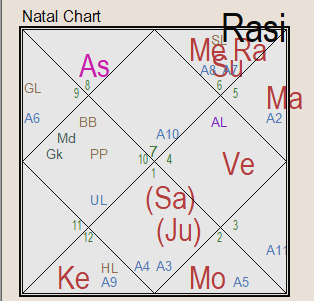
One such monk was Shastri Muni Maharaj, widely revered in North India. He lived as a true yogi, surrounded by seekers, consulted for guidance and predictions, and known for intuitive and psychic abilities. Please see his natal chart below
The chart above is his with tula lagna. I don’t have the exact time to present full details.
During personal interactions, he shared charts of other Jain monks for analysis and eventually revealed his own horoscope. Although the exact birth time is no longer available, two combinations stood out clearly and he pointed these to me. Mercury Sun Rahu combination in the twelfth house. Mercury is the exalted twelfth and ninth lord and is in the twelfth house. There is also an exchange between 10th and 8th lords with both being benefic. Also, his Moon the tenth lord exalts in the eighth house, giving him access to realms and psychic powers.
1. Exchange Between 10th and 8th Lords (Karma–Moksha Axis)
A 10th–8th lord exchange is highly significant in spiritual horoscopes.
The 10th house represents karma, action, public role.
The 8th house represents transformation, occult knowledge, death of ego, and deep tapasya.
When these lords exchange signs:
Worldly karma becomes a vehicle for inner transformation.
Public life dissolves into spiritual purpose.
Action is no longer for status, but for transcendence.
In monastic charts, this exchange often shows:
Early withdrawal from material profession.
A life devoted to guiding others spiritually.
Comfort with secrecy, silence, and ascetic discipline.
This aligns perfectly with Jain monkhood, where one abandons all social identity yet becomes a karmic reference point for others.
2. Saturn–Jupiter Conjunction in the 7th House
A Saturn–Jupiter conjunction is rare and powerful, especially for spiritual authority. Both planets are retrograde.
Spiritual energy is transmitted through dialogue, presence, and gaze.
This placement does not indicate marriage in ascetic charts. Instead, it shows:
One-to-one spiritual influence.
The ability to read others’ karmas.
Authority acknowledged without force.
Many yogis with psychic perception have this exact combination, especially when unafflicted and supported by moksha houses.
Unfortunately, my private sessions with him were short-lived, as he passed away in April 2016. Interestingly, I was myself running Saturn–Ketu dasha at that time. He told me not to give up astrology. He encouraged me to keep practicing it. These words have guided my journey ever since.
Understanding Saturn’s Role in the Native’s Life: A Deep Dive into the Saturn Mahadasha
In Vedic astrology, the study of planets and their influence on an individual’s life is not merely an academic pursuit; it is a profound spiritual journey that unveils deeper karmic lessons. One of the most significant periods in a native’s astrological life is the Mahadasha of Saturn, the planet known for its slow, steady, and often challenging influence. This article will explore how Saturn’s Mahadasha has unfolded for a native with Sagittarius ascendant, born in 1984 in North India, as well as the lessons Saturn brings during its period. Other birth details are withheld to protect the native’s privacy.
The Karmic Lessons of Saturn’s Mahadasha
While Saturn’s position in the eleventh house and its conjunction with the Sun indicate potential wealth and gains, the challenges the native is facing during this period are significant. Saturn in Vedic astrology is known as the great teacher, and its lessons are often harsh but ultimately transformative. It is through enduring these trials that the individual’s soul grows.
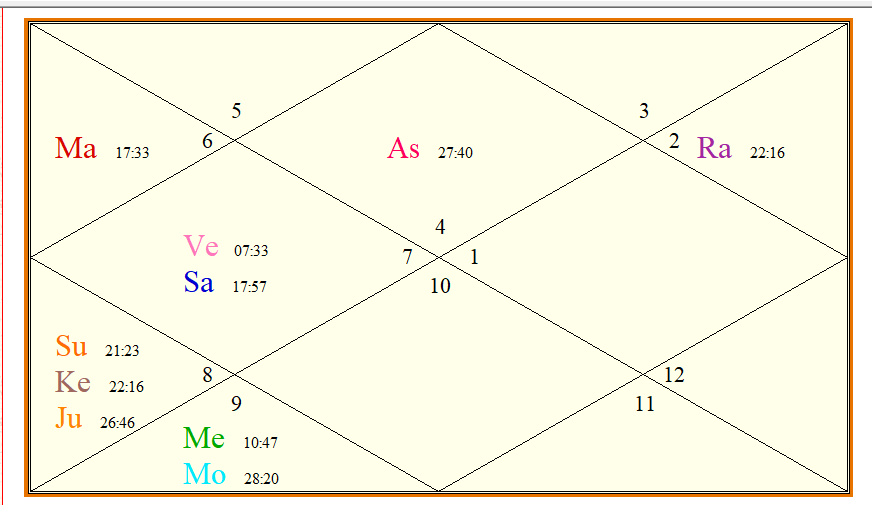
This Saturn is in the Eleventh house and is in its exaltation sign. This means the native has a Sagittarius ascendant. The second and third lords are exalted in the eleventh house. What does this signify? This is a major dhanayoga. It is activated as per the principles of the second lord in the eleventh. This happens with a good dignity, i.e. exaltation, and also with a malefic in the eleventh house. This Saturn is conjunct Sun, the ninth lord making Sun debilitated. Ninth lord in eleventh is activating another dhanayoga and the debilitation of Sun gets canceled as it is conjunct exalted Saturn. Would you predict a rise in fortune and a lot of gains for this native? Not unless you look at the big picture that is the whole horoscope and the divisional charts, dasha and transit. Now, let us look at the horoscope.
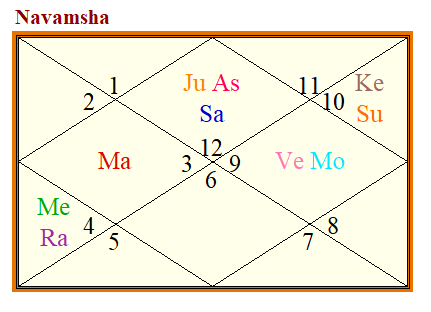
As of May 28, 2024, the past three years have been a period of profound hardship for the native. His wife has left him. She has also filed false legal cases against both him and his family. As a result, he is entangled in ongoing court battles. This Venus Mercury combination is 6th 7th lords conjunction in the 12th house of loss and with another seperative planet ketu. Remember 6th house is court cases as well. Soon after, his father fell seriously ill and passed away. The hospital medical expenses for his father’s month-long treatment amounted to a lot of money, further adding to his financial burden. Alongside this, his only son, whom he deeply cherishes, now lives with his mother. All these significant events have unfolded during the Dasha of Saturn-Mercury, illustrating the powerful and often difficult lessons brought by Saturn. Over the last 4-5 years, his life has been dramatically reshaped. The influence of Mercury in Scorpio, positioned in the twelfth house as the seventh lord along with Venus and Ketu, has played a key role in these challenging circumstances. This Mercury is again in the twelfth house of navamsha aspected by Saturn and Venus. Navamsa Mercury is aspected by Venus from the sixth house, remember Venus is the sixth lord in the rasi chart.
Now, let us delve into the reasons behind these events and explore the deeper astrological factors at play.
The separation of the native’s wife, death of father, and his emotional separation from his son represent deep karmic lessons. In the same way that Karma dictates the course of the soul’s journey, Saturn in its Mahadasha pushes the individual to confront and resolve unresolved karmas, often through hardship. These events are not random; they are part of a greater plan to help the soul evolve and achieve a higher state of spiritual awareness.
Karma teaches us that each action has a consequence, and it is through enduring these consequences that we achieve ultimate liberation. In the case of this native, Saturn’s period has been difficult, but it will lead to greater wisdom and maturity.
Sade Sati of a Kemadruma Moon
In addition to the ongoing Saturn Mahadasha, the native also entered his Sade Sati period when Saturn began its transit through Capricorn. Sade Sati, a 7.5-year period where Saturn transits over the Moon, is often associated with significant challenges, delays, and obstacles. For this native, this period has been especially difficult due to multiple astrological factors.
The most challenging phase of his Sade Sati came when Saturn transited Aquarius, which proved to be the worst period for him. In Ashtakavarga, the third house, which governs communication, courage, and effort, consists of only 22 points. This low point score indicates a period of struggle, particularly in matters requiring personal initiative, communication, and resolving conflicts. The third house, being weak in points, suggests that the native faced tremendous difficulties in overcoming obstacles, and his efforts to assert himself and make progress were met with considerable resistance. Notice, in Ashtakvarga both the seventh house and the 12th house where seventh lord is placed with Ketu and the sixth lord venus have lower points, 21 and 20 respectively.
Furthermore, this native’s Moon is placed in a Kemadruma yoga, meaning it is devoid of any planets on either side (i.e., there are no planets in the second and twelfth houses from the Moon). In Vedic astrology, the Kemadruma yoga is often considered a malefic combination, signifying emotional isolation, loneliness, and a lack of support from the external world. This placement makes the native feel emotionally vulnerable and unprotected, especially during challenging planetary periods such as Sade Sati. The Moon, representing the mind and emotions, becomes weaker in such a position, leading to mental stress, emotional turmoil, and periods of depression or confusion. There is also kemadruma bhanga as there are planets in kendra from Moon. However, the effects are still felt.
During Sade Sati, Saturn’s transit over the Moon brings additional weight to this isolation. The native feels burdened not just by external events but by internal emotional struggles as well. It is a time when the lessons of Saturn—patience, perseverance, and self-discipline—are magnified, but the absence of support from surrounding planets makes these lessons even more difficult to bear.
In sum, the Sade Sati, combined with the Kemadruma Moon and the malefic effects of Saturn’s transit, has created a period of hardship for this native. The low Ashtakavarga points in the third house indicate struggles with communication and overcoming obstacles, while the Kemadruma Moon exacerbates emotional isolation. The native’s journey through this challenging period is one of profound transformation, teaching him the importance of resilience and self-reliance, although it may come with great emotional and mental strain.
The Role of Malefics in the Trishadaya Houses
In Vedic astrology, malefic planets placed in the Trishadaya houses—the third, sixth, and eleventh houses—can bring about significant transformations, though not without considerable effort and perseverance. These houses, associated with effort, conflicts, and gains, are often seen as places where hard work is required to realize the benefits associated with the malefic planets.
The third house governs courage, communication, and personal effort. The sixth house represents service, health, debts, and obstacles, while the eleventh house signifies gains, aspirations, and social networks. When malefic planets like Saturn, Mars, or Rahu are placed in these houses, they tend to challenge the individual, but the rewards can be significant once the native overcomes these obstacles.
As a general principle, malefics in these houses may not indicate immediate rewards, but they promise long-term success that comes only after facing difficulties. These results are often realized when the native is undergoing Dasha periods of the associated malefic planet.
In the case of this native, Saturn Mahadasha began in July 2019, and we are now witnessing its profound impact on his life, especially in the fields of career, relationships, and financial matters. Let’s explore this in more detail.
Saturn in the Eleventh House: A Powerful Dhanayoga
The native’s Saturn is placed in the eleventh house in Libra, a position that is considered auspicious in many ways, particularly because Saturn is in its exalted sign. Saturn, as the second and third lord, represents the native’s family, finances, speech, and efforts. When placed in the eleventh house, Saturn’s influence suggests that while the native may experience financial gains, those gains will not come easily. Saturn demands consistent, hard work, discipline, and long-term effort.
In this native’s case, Saturn’s influence is activating a major Dhanayoga (a combination for wealth) because the second lord (finances) and third lord (effort) are exalted in the eleventh house. This means that the native is likely to see material rewards as a result of his hard work and perseverance, although these gains may be delayed and hard-earned. This aligns with the teachings of Saturn, the planet that governs karma—its effects are often not immediate, but they manifest when one has proven their worth through hard work.
However, despite the promise of financial gains, the native’s Saturn is also conjunct the Sun, the ninth lord, a position that causes the Sun to become debilitated. This conjunction is significant because, in Vedic astrology, the ninth house represents fortune, dharma (righteousness), and fatherly figures. When the Sun is debilitated, it can indicate challenges in these areas, and in the case of this native, the loss of his father during Saturn’s Mahadasha reflects the karmic influence of this conjunction. This Sun’s debilitation gets cancelled as it is involved in Neechabhanga Rajayoga. The presence of Saturn, exalted in Libra, cancels the debilitation of the Sun, creating a Neechabhanga Raja Yoga. This is because Saturn, being strong in Libra, can give the Sun a boost, elevating its status from a debilitated position to a more favorable one.
The Role of Mercury and the Influence of the Twelfth House
The Mercury Antardasha (sub-period) began shortly after the start of the Saturn Mahadasha and has played a crucial role in shaping the events of the native’s life. Mercury, positioned in the twelfth house, represents losses, expenditures, and isolation, and is the ruler of the seventh and tenth houses of partnerships and career, respectively. In Vedic astrology, the twelfth house is associated with spiritual growth, but also with hospitalizations, foreign lands, and hidden expenses.
Mercury in scorpio in the twelfth house has been a catalyst for many of the challenges the native has faced, including court cases, financial burdens, and emotional separations. The conjunction of seventh and the sixth lords with ketu and in the twelfth house. The seventh house (partnerships) and tenth house (career) being governed by Mercury indicate that these losses are primarily related to business partnerships, legal issues, and professional setbacks. The native has encountered severe financial losses, including a massive hospital bill for his father’s treatment, which reflects Mercury’s influence over expenditures and hidden costs.
Looking Forward: Opportunities After Hardship
Despite the hardships the native has faced, the eventual rewards of Saturn’s Mahadasha are clear. The native’s financial and professional prospects are likely to improve once the tough lessons of Saturn’s period are learned. The key is to endure with patience and humility, as Saturn rewards those who remain committed and disciplined.
In the coming years, as Saturn moves through other significant houses and as Mercury’s influence wanes, the native is likely to see a shift toward more favorable outcomes. This could manifest as better career opportunities, a redefined relationship with his family, and possibly new avenues for financial growth. As the native’s hard work starts to pay off, he will experience a renewed sense of purpose, much like Arjuna in the Mahabharata, who, after much hardship and struggle, ultimately achieves victory.
The native’s Saturn Mahadasha has been marked by profound challenges, but also significant karmic lessons. Saturn’s placement in the eleventh house offers great potential for financial gains, but these will not come easily. The influence of Mercury in the twelfth house has added layers of complexity, including legal issues and financial setbacks, which are all part of the soul’s growth process during Saturn’s period.
Ultimately, the native’s journey is a reminder of the powerful teachings of Saturn in Vedic astrology. While its lessons are often hard and come through adversity, they are necessary for the soul’s ultimate evolution. Like the great stories of the Vedic tradition, the native’s life is a tale of struggle, growth, and eventual triumph.
December 2024 Update
As of December 2024, there has been a significant shift in the native’s life. The challenges that once seemed insurmountable have started to ease. His wife, who had previously filed numerous court cases against him, has now withdrawn all of them, providing a sense of relief and closure. This marks the end of a prolonged period of legal battles, offering the native a chance to rebuild both personally and professionally.
In terms of his career, the native made a bold decision to sell his property and invest in a new direction within his existing domain of jewelry. With determination and hard work, he has laid the foundations for his new business venture. Though the journey has been slow and steady, the results are beginning to show. The profits are gradually increasing, and the native is now witnessing the fruits of his labor. His perseverance is paying off, and a positive outlook is gradually replacing the doubts and hardships of the past few years.
A significant factor contributing to this turnaround is the influence of exalted Saturn in the eleventh house. Saturn, in its exalted position, has been fulfilling its promise of Dhanayoga—a combination that signifies financial gains and the realization of long-term goals. The eleventh house, associated with gains, networking, and desires, is further amplified by Saturn’s disciplined and structured approach. This placement indicates that, despite the obstacles faced earlier, the native is now entering a phase of gradual but sustained prosperity. The rewards from his hard work, resilience, and business acumen are starting to manifest, aligning with Saturn’s teachings of patience and persistence.
The positive change in his financial situation, combined with the emotional healing from the withdrawal of the court cases, reflects the steady progress he is making towards stability and success. The journey has been tough, but with Saturn’s guiding influence, the native is now on a path of recovery and growth, both in his personal and professional life.
I am writing this article when 5 planets align in the sky and are visible from earth, including Jupiter.
Vargottama planet is in the same house in the rasi chart and navamsa. This gives the planet strength.
Exaltation: Exaltation is the best thing that can happen to a planet in terms of strength.
In Vedic astrology, when a planet is considered exalted, it means that the planet is in its strongest and most favorable position within a specific zodiac sign. The exaltation of a planet enhances its positive qualities and gives it a heightened influence in a person’s horoscope.
As per Sh. K.N Rao:
A planet will give strong and beneficial results in its dasha and antardasha in majority of cases if:
It is the Lagna Lord
It is the 10th Lord/ Lord of House of Karmas and Profession
It is Exalted
Let us see this with an example of a native who ran the dasha of an exalted and vargottama Jupiter, the guru.
A male born in 1990 in Delhi, India with dasha balance of Jupiter 15 y 1m.
Jupiter’s deepest exaltation is at 5 degrees in Cancer.
This Jupiter is at 2 degrees and 7 minutes, very close and heading to deepest exaltation.
This Jupiter is in its strongest kendra, i.e. the 10th House also forming a beautiful Hamsa Yoga.
This Jupiter repeats its position in the 10th from Moon, again in 10th forming an excellent Gajakesari Yoga.
It is exalted in Navamsa, making it vargottama.
This Jupiter is powerful to do good and bestow the native its significations of the houses it owns. However, this Jupiter is a malefic for Libra lagna as it owns 3rd and the 6th houses.
Career Analysis:
The native enjoys a good 10th house and 10th lord in lagna is involved in Rajayoga by placement in the 1st house and aspect by 7th lord Mars who is in its mooltrikona sign Aries forming a Ruchaka Mahapurush Yoga as well and Chandramangal yoga.
The tenth house has Jupiter, Sun and Ketu. jupiter is exalted, Sun as 11th lord is having directional strength.
He has a good promise of career in his chart. Now comes the dynamic analysis- Dasha, i.e. When?
In the year 2020, in the Saturn Rahu dasha this native asked me how his career will be as he was not happy with the salary and his growth in his career. He is an HR in Canada. I told him you will grow in your career and earn a six figure salary in the coming three years and buy a house.
He laughed it off, he was only earning half of what I had predicted at the time and a six figure salary was a distant dream.
Now, Let’s analyze the Saturn Jupiter Dasha for him:
This horoscope has strong kendras as many planets occupy it.
Saturn: Yogakaraka for Libra lagna in the third house of self efforts aspected by Venus, forming a strong Rajayoga. This Saturn is vargottama too and Venus is exalted in Navamsha making them both have a strong dignity and strength.
Jupiter
It is exalted and vargottama. Moreover, it is own house in Dashamsha connected to the 10th house of D10. Remember, it is in the 10th house in D-1/ rasi chart.
In rasi chart, antardasha lord being in 6/8 axis with the Mahadasha Lord Saturn and a malefic lord for Libra were my concerns.
6th House in modern age is the house of service and being a Upachaya house lord the native will get results only after a lot of hard work.
This Jupiter is sitting with the eleventh lord, Sun and being aspected by seventh and second lord Mars, activating Dhanayoga.
By the time of writing this article in March 2023, he has only finished half of his Jupiter Antardasha and is now earning way more than a six figure salary. He has to work more than 10 hours on weekdays as he now is a Manager, HR.
This Jupiter is also aspecting the second house .
Do you think he can buy a house?
The answer is in the rasi chart itself, and the D4 chart or chaturthamsa confirms it.
Jupiter aspects the 4th House in both cases.
This is the power of an exalted and a vargottama Jupiter.
How was this conceived by the rishis thousands of years ago?
Edit: The native bought a house in end of June 2023, 4 months after writing this article in the dasha of Sat Jup Ven as predicted. Jupiter is transiting in Aries and Saturn is transiting in Aquarius.
A Horoscope has 12 Houses. Each House signifies something important in your life. See below a list of important significations which one can check from each house:
1st House: Self, health, physical body, longevity, body appearance
2nd House: Accumulated wealth, kutumba(family one is born in), early childhood, speech, food you eat. It is also a maraka house.
3rd House: Art, co-born especially younger siblings, self-efforts, hobbies, courage, short travels, neighbors
Combinations of Rajayogas and Dhanayogas occurring in trik houses acquire a new meaning in today’s day and age. If we apply the same principle as written in shastras we can go wrong. Therefore, as said by Sh. K.N Rao apply principles from classics liberally and not literally.
Lets us understand this with an example:
Chart of a businessman born in 1964
Notice the following yogas:
Sasha Yoga: Saturn in own house(mooltrikona) in 10th
Malavya Yoga: Venus in own house in lagna as lagna lord. Notice the degrees of Venus and ascendant
He has concentration of planets in the 12th House: Mer(R), Jupiter and exalted Sun
This concentration of planets in the 12th house forms rajayoga and multiple dhanayogas aspected by a yogakaraka Saturn which is in turn in its mooltrikona sign. Also, notice the exchange of 11th and 12th lords. This makes the 12th house very powerful.
Let us look at the dasha pattern along with navamsa:
Career: Second half of Dasha of Rahu was uneventful for him as he did a lot of hardwork but had very little to show for it. He was doing a business related to educational materials.
Jupiter Mahadasha: Post 2000 as he was in the beginning of the dasha of Jupiter he started to get contracts for exports. Notice this Jupiter participating in all the dhanayogas and rajayogas and in the 12th house of exports.
For Taurus lagna, Jupiter is a malefic as it owns the eighth and the eleventh houses and placed in the twelfth. Throughout the Jupiter dasha he got one contract after another and built a high sustaining business around it and has earned in millions.
The blemish of Jupiter came to him as a health issue in Jupiter Venus period which was very serious for a couple of years, but he overcame that and now is in good health. Therefore, Jupiter did give its effects as the eighth lord and Venus AD is the sixth lord as well.
He continues to do better in his Saturn Mahadasha which is also the yogakaraka.
This is an example of Dhanayogas and Rajayogas in the 12th house giving extremely positive results for the native.
Dashamsha confirms the rise as all the planets involved are strong and participate in multiple Rajayogas.
This horoscope is of a male from New Delhi, India and migrated to Canada in 2015 in the dasha of Saturn Venus.
He has 6 planets in moveable rasis.
Rahu is the 4th house also gives a promise of leaving home and settling away.
Venus the antardasha lord is in the 9th house of long journeys.
Saturn Venus in the 3-9 axis gave the result in its dasha.
Let us check the chaturthamsa or D4
In chaturthamsa, his 4th lord Saturn is in the 12 house and it is the Mahadasha lord.
Venus the Antardasha lord is in the 3rd house of change/resettlement.
He went on the basis of education, can you justify from his main chart the connection of his education and foreign countries.
12th Lord Mercury aspect on the 5th house is the static promise in the rasi chart. It repeats from Moon as Moon is in the lagna.
Chart 2
This male student went to a foreign country for studying Bio Technology.
Venus in the 5th house as 5th lord is also the 12th lord.
Dasha of travel- Rahu Moon
Rahu is the significator of everything foreign and Moon is in Rahu Ketu axis. Moon is also in the eighth house.
He will follow this dasha with the dasha of Jupiter, Jupiter as 10th lord in 11th is connected to 12th lord Venus signifying career in a foreign country.
Chaturthamsa Analysis: Rahu Moon again conjunct in itself is enough, they are also aspected by 9th Lord Venus.
Chart 3
4th lord and House afflicted. Left home country in the dasha of Mercury Rahu.
Mercury with 12 lord in Rahu Ketu Axis and Rahu is the significator.
D4/Chaturthamsa Analysis:
Dasha of Mercury Rahu in D4 is connected with D4’s 12th lord as well.
Chart 4
Female went abroad to study, now has a property and settled there.
4th Lord aspected by 12th Lord.
She went in the dasha of Saturn Ketu, can it get an easier than this. Saturn in the 12th and Ketu aspected by 12th lord and itself in the 9th house.
Let us check her D4
4th Lord Moon aspected by 12th lord Jupiter and dasha of Saturn Ketu gave the result.
Chart 5
Born in India and now a Canadian Citizen.
10th-12th Lords exchange depicting career in a foreign country.
12th lord aspect on the 4th house is the static promise as well.
He has excelled in his career(exalted 10th lord) and has bought a house in a foreign country too.
In this Case Study I will discuss a horoscope in which a young man died at the age of 34 with liver disease.
Birth Chart
Male born in New Delhi in 1983
This is a classic example of a Balarishta Chart. Moon in 6th House with 12th lord is afflicted by malefics Sat&Mars. Moreover, Moon is also the Lagna Lord making this a severe arishta combination.
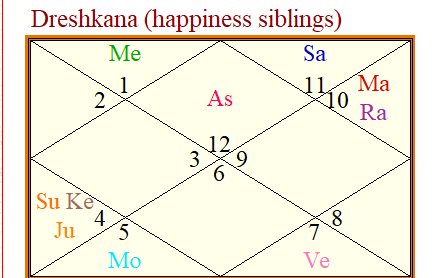
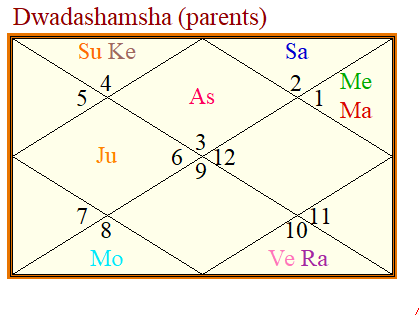
Now, let us check this moon in Navamsha and Drekkana and Dwadashamsha
In all 3 charts Moon which is also the lagna lord is severely afflicted showing no respite with regards to the health of the native.
In such cases with severe Balarishta combinations the survival of the child upto 12 years is difficult, especially since he will run the dasha of Moon from 1989 to 1999. But there is also Balarishta cancellation combinations because of which he survived during young age.
Jupiter Aspect on Lagna and ShuklaPaksha Night Birth are two of the major reasons.
Exalted Saturn as 8th Lord with 11th lord in a kendra add some years to the native’s age but only to some extent.
This Horoscope came to me in 2015 with health complications and severe career issues.
He was running Sadesati as well with Poor Ashtakvarga scores in 1st and last phase of 2.5 years.
He was warned with severe health conditions in future if he doesn’t improve his lifestyle as he had taken to drinking heavily with a faulty liver. Longevity wasn’t calculated or warned.
He passed away in Jan2017 in the dasha of RaVen. Notice Venus is the chiddra graha as it is the 8th lord of D3 placed in 8th house in D3. It is also placed with exalted 7th lord in D1 making Saturn potent maraca in this case.
Let’s use the PAM method to check his longevity.
Note: PAM method is not a full proof method, you must use other ayu calculation methods along with and the Horoscope only will show you the best picture.
For Healh/Longevity Study
Lagna/Lagna Lord
Moon
3H/3 Lord
8th House/8th Lord
10th House/10th Lord
And Saturn.
Study these combinations along with dasha and transits.
Here as we can see Lagna Lord and Moon are under severe arishta.
Only the condition of 8th lord and Saturn is good enhancing his age to 34 years.
Now let us see PAM method,
To understand this method in detail, refer to my video with link below:
LagnaLord: Dual
8th Lord: Moveable
Result: Alp
Lagna: Moveable
Moon: Dual
Result: Alp
Therefore, PAM method signals to Alp Ayu 0-36 years but check main Horoscope to make sure for harans and Bharans and come to a final conclusion.