
Author: sid0817

  • Case Study 01: Vehicular Accident/D-16

    Case Study 01: Vehicular Accident/D-16

    Vehicular Accident

    s

    This individual met with a bike accident in the dasha of Jup/Mar/Rahu.

    Promise: Connection of 4 and 6 Houses/lords is one of the criteria for vehicular accidents. In this case 6th lord Sat is in the fourth house.

    So the promise of accident is there.

    Venus the karaka is comfortably sitting in its mooltrikona sign but is in paapkartari also aspected by jup the eighth lord.

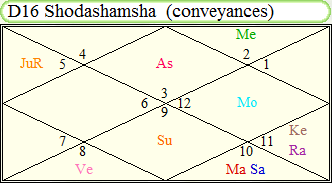
    Check D-16 as 4th house in D-1 can mean many other things aswell, so we confirm in D16 as it is the chart for conveyances.
    d

    Here 4th lord of D1 and 6th lord of D1 are conjuct in the 8th house which is the 6th house of D1 confirming the chances of accident.

    *Studying D1 lords in D16 shows us the picture more clearly in this case.

    Now the question comes When?

    Well, it can be in the antardashas of Saturn(6th Lord) or Mars(4th Lord). Both are in the 8th house in D16.

    Dasha at the time of accident: Jupiter/Mars/Rahu. This individual met with a bike accident and damaged his left knee and feet for life and underwent 5 major surgeries.

    Jupiter: Eighth lord of D1 also a maraka as it is sitting in the seventh house.

    Mars: Planets do give results as per their natural karakatwas, in this case Antardasha of Mars led to an accident. Mars is the lord of fourth house of vehicles where 6th lord is placed.

    Rahu’s Pd gave the final blow as it is in the 8th house in D1 and aspected by Mars/Mer.

    JupMars dasha is a dasha of 6/8 axis in D16 with the 6th lord Mars aspecting Jupiter with its eighth aspect.

    This individual has to be careful in Sat/Mars Dasha too as there is a chance of another accident.

    On the day of transit 6 planets were in the second house from lagna of D1 i.e in Virgo aspecting the 22nd dreshkona.

    New things to learn in this example:

    Technically the dasha of Jup/Mars should have been excellent for him as it was his yogakaraka dasha but it wasn’t the case.

    D16 gave us a clearer picture about the accident.

  • How to read a Navamsa chart?

    How to read a Navamsa chart?

    “If Birth Chart is a tree, Navamsa chart is the fruit in that tree.”

    K.N.Rao

    Navamsa is the ninth division of a horoscope and is one of the most important divisional chart to be studied along with the  D-1/ main chart. In the Vimshopak Bala given by Parashara  it is given 3 points after shastiamsha and the birth chart. Shastiamsha/D60 is given the highest weight-age of 4 points higher than the birth chart which has 3.5 points.

    Clearly D60 is the most important chart but since it changes every two minutes the accuracy of its lagna is doubtful as in most of the charts, the timing is off by a few minutes.

    The Birth Chart changes every two hours and so many children are born in the same state during those two hours, each having same lagna. Their fates will change according to the paatra but not all will have similar destiny. That is where navamsa and other divisional charts come into picture.

    Navamsa Chart has to be read in following ways:

    1. To check the strength of a planet: The most important use of the navamsa chart is to check if the planet is really strong. If a planet is exalted in the birth chart and debilitated in the navamsa then the planet’s inherent strength is not there. The planet will only give good results in the first half of its dasha and will give poor results in his next half and vice versa. This is the reason why we should also check the planet’s dignity and strength in navamsa before reading a chart.
    2. Read it independently: Some astrologers read it as a mirror chart to the main chart and confirm the events. If D1 and D9 show the same event for eg: In a students chart, in D1 5th lord has connection with 12th house/lord and the dasha is also running then the education can be outside the home city(one of many things). If the same combination of the D9 lords repeats then it is a certainty.
    3.  Marriage Chart: This chart is read independently to know all the attributes of spouse and to time the marriage of an individual as well.
    4. RasiTulya Navamsa: It is the super imposition of navamsa chart over rasi chart, i.e. keep the rasi chart lagna as it is and place the planets in the horoscope as per their positions in the rasi chart. It tells us how the lords have shifted in the navamsa and can be used to predict as well.

    Therefore it is important to read the Navamsa Chart/D9 always along with D1.

  • Dhanyoga: MoneyMaking periods in Astrology

    Dhanyoga: MoneyMaking periods in Astrology

    Dhanyoga: The combination for Wealth.

    How to see which periods are useful to make money in astrology-

    The chart made at the time of birth shows us our static promises but the combinations in this chart only work with the dasha system which is the dynamic promise of a horoscope. Transit delivers us the result.

    Close analysis of all above parameter helps us delineate any event.

    Second House: This house signifies accumulated wealth in a horoscope, the food we eat, speech, the family we are born in and also death.

    Eleventh House: It is the house of gains, profit, friends, honours. Any planet connected with this house/lord, it’s significations multiplies, therefore the second lord and eleventh lord combination results in high amount of wealth and if connected to a trikona lord then the gain is way better.

    First, Fifth and Ninth House: Trikonas/Trines are known as laxmi sthanas in astrology, first house acts as both kendra and trikona, 9th being the strongest trikona.

    When any of the above lords/houses combine with each other in the horoscope it leads to a dhanyoga and when the dasha related to these planets comes the person tends to earn a lot of money during this period.

    The amount of money depends on the influences, dignity and strength of planets forming the yoga and the house in which it is formed shows you the type or means of making money.

  • Moon and Astrology

    Moon and Astrology

    Moon is the most important planet in Vedic Astrology. It is the seed of a horoscope. Moon represents the mind of a person, his subconscious,his mental inclinations; the reason why the moon chart is so important in astrology. Many a times the results come out more correctly from Moon chart rather than the Ascendant.

    Persons dominated by a strong moon are dreamers, they are controlled by imagination,they are very creative and do not like the materialistic aspect of nature. They love Beauty and try to see the positive side of everything which also makes them very sensitive and caring. Travel is one thing which people with strong moon love to do, they seldom stay at one place. They are the one who build air castles, plan great things but seldom put them into operation because they have little practical value. Their world is full of imagination, they are very lazy and prefer to live in the dreamworld. They are restless and do not stay at one place because of which they love to travel.  In the charts of musicians, singers, writers, travelers Moon is strong.

    These people are driven by emotions, they are not practical which makes them romantic and loyal partners.

    They have a strong bond with their Mother as Moon represents mother in one’s chart. The various aspects on moon along with the Fourth House tells one about the bonding they with their mother and the also well being of the mother.

    Moon’s placement in various Houses further effects those houses in a lunar way and enhances the significations if the moon is well placed and well aspected.

    Let’s consider Moon in Seventh House,

    Seventh house is he house of romance, marital happiness, partnerships, foreign among many other things.

    When strong moon is placed in the seventh house, the native gets a beautiful and charming partner. He is compassionate, gets easily influenced by the opposite sex, desires to live in a foreign country. Gains from foreign trade, water products, loves to travel.

    Moon decides the dasha balance one gets in life which times all the events that takes place in life. It travels the entire zodiac in 28 days.

  • The Science Behind Jyotisha: Astrology Meets Astronomy

    The Science Behind Jyotisha: Astrology Meets Astronomy

    Jyotisha: The Ancient Science of Vedic Astrology

    Jyotisha, or Vedic Astrology, has been a cornerstone of Indian wisdom for thousands of years. As one of the six Vedangas (limbs of the Vedas), it represents a holistic blend of astronomy, philosophy, and spirituality. Jyotisha studies planetary movements and their influence on life from a geocentric perspective, Earth’s point of view. Remarkably, the astronomical calculations of planetary distances, movements, and sizes documented in ancient texts align closely with modern scientific standards.

    This profound science serves as a tool to study time’s impact on individuals, societies, and nations. Rooted in the principles of karma and reincarnation, Jyotisha aims to guide individuals toward spiritual growth and holistic upliftment. Its essence lies not merely in prediction but in aiding self-awareness and aligning one’s life with cosmic rhythms.

    The relationship between the grahas (planets) and human life might seem enigmatic, yet it underscores a deep interplay between the universe and individual existence. The microcosm-macrocosm analogy sheds light on this interconnection, suggesting that the patterns in the cosmos mirror those within us.

    At a philosophical level, Jyotisha invites us to explore profound questions about destiny and free will. If life events are preordained, what role does free will play in shaping our journey? This paradox continues to intrigue seekers and scholars, bridging the realms of science, spirituality, and human inquiry.

    The stars impel, they do not compel. Let’s find your path.