Tag: Vedic astrology basics

  • How the Navamsa Is Calculated: The Math Behind the D9 Chart

    Every Jyotisha student hears early on that the navamsa (D9, the ninth divisional chart) is the most important chart after the rashi chart. It is read for marriage, for dharma, and for the real strength of every planet. A planet that looks strong in the rashi chart but falls weak in the navamsa often fails to deliver. The old saying puts it simply: the rashi is the tree, the navamsa is the fruit.

    Most of us let software draw the navamsa. But the calculation is simple, and once you see it, you will understand why a few minutes of birth time can change a chart, and why some planets are called vargottama.

    Step 1: Cut each sign into nine parts

    Nava means nine and amsha means part. Each sign of 30° is divided into nine equal parts:

    30° ÷ 9 = 3°20′ (three degrees and twenty minutes)

    In minutes of arc, that is 1,800′ ÷ 9 = 200′ per navamsa.

    So the zodiac has 12 × 9 = 108 navamsas. This number is not an accident. The zodiac also has 27 nakshatras of four padas (quarters) each, and 27 × 4 = 108. Each navamsa is exactly one nakshatra pada. When software tells you the Moon is in Krittika pada 4, it has already told you the Moon’s navamsa.

    Step 2: Find where the count starts

    This is the only rule to learn. The count of nine does not start from the same sign every time. It depends on the element of the sign:

    Sign groupSignsCount starts from
    FireAries, Leo, Sagittarius1, Aries
    EarthTaurus, Virgo, Capricorn10, Capricorn
    AirGemini, Libra, Aquarius7, Libra
    WaterCancer, Scorpio, Pisces4, Cancer

    Readers of my article on the trikonas will notice something. Each group is a triangle of signs 1, 5 and 9 from each other, and the count starts from the movable (chara) sign of that triangle.

    Parashara gives the same rule in another form in Brihat Parashara Hora Shastra: for a movable sign, the count starts from the sign itself; for a fixed sign, from the 9th sign from it; for a dual sign, from the 5th. Check it with Taurus, a fixed sign: the 9th from Taurus is Capricorn. With Gemini, a dual sign: the 5th from Gemini is Libra. Once again, the 5th and the 9th. The navamsa is built on the trikona.

    Step 3: The full navamsa table

    Putting Steps 1 and 2 together gives the whole navamsa in one table:

    NavamsaDegrees in the signFire signsEarth signsAir signsWater signs
    10°00′ to 3°20′AriesCapricornLibraCancer
    23°20′ to 6°40′TaurusAquariusScorpioLeo
    36°40′ to 10°00′GeminiPiscesSagittariusVirgo
    410°00′ to 13°20′CancerAriesCapricornLibra
    513°20′ to 16°40′LeoTaurusAquariusScorpio
    616°40′ to 20°00′VirgoGeminiPiscesSagittarius
    720°00′ to 23°20′LibraCancerAriesCapricorn
    823°20′ to 26°40′ScorpioLeoTaurusAquarius
    926°40′ to 30°00′SagittariusVirgoGeminiPisces

    Step 4: Worked examples

    Astrologers often write a position as signs completed plus degrees. Aries is 0s, Taurus 1s, Gemini 2s, and so on, so 4s 5°10′ means four signs are completed and the planet is 5°10′ into the fifth sign, Leo. The signs are also numbered 1 to 12 from Aries, so the count starts from 1 (Aries) for fire, 10 (Capricorn) for earth, 7 (Libra) for air and 4 (Cancer) for water.

    Example 1: Sun at 4s 5°10′ (Leo 5°10′)

    5°10′ falls between 3°20′ and 6°40′, so this is the 2nd navamsa of Leo. Leo is a fire sign, so the count starts from 1, Aries. The 2nd sign from Aries is Taurus.

    Example 2: Moon at 1s 8°10′ (Taurus 8°10′)

    8°10′ falls between 6°40′ and 10°00′, so this is the 3rd navamsa of Taurus. Taurus is an earth sign, so the count starts from 10, Capricorn. The 3rd sign from Capricorn is Pisces.

    Check it with the nakshatra: Taurus 8°10′ is Krittika pada 4, and the fourth pada of Krittika falls in Pisces navamsa. The two methods agree.

    Example 3: Venus at 11s 29°00′ (Pisces 29°00′)

    29°00′ falls between 26°40′ and 30°00′, so this is the 9th navamsa of Pisces. Pisces is a water sign, so the count starts from 4, Cancer. The 9th sign from Cancer is Pisces.

    Venus is in Pisces in both charts. This is called vargottama.

    Step 5: Vargottama, worked out

    A planet is vargottama (best in its division) when it occupies the same sign in the rashi and the navamsa. Such a planet is treated as strong, and an exalted planet that is also vargottama, like the Venus above, is especially so.

    The math tells us exactly where this can happen:

    • In a movable sign, the count starts from the sign itself, so the 1st navamsa (0°00′ to 3°20′) is vargottama.
    • In a fixed sign, the count starts from the 9th. Count forward four more and you are back home, so the 5th navamsa (13°20′ to 16°40′) is vargottama.
    • In a dual sign, the count starts from the 5th. Count forward eight more and you are back home, so the 9th navamsa (26°40′ to 30°00′) is vargottama.

    So each sign has exactly one vargottama zone of 3°20′, and the 12 zones together make up one ninth of the zodiac.

    Step 6: Why the birth time matters so much

    The lagna moves through a whole sign in about two hours, so it moves through one navamsa in roughly 10 to 15 minutes. Take two births a few minutes apart:

    LagnaNavamsa of AriesNavamsa lagna
    0s 3°15′1st (0°00′ to 3°20′)Aries (vargottama)
    0s 3°25′2nd (3°20′ to 6°40′)Taurus

    The rashi chart is the same, but the navamsa lagna has moved to a new sign, and every house in the navamsa has shifted with it. This is why careful astrologers check the birth time against past events before reading the navamsa, and why a lagna near the edge of a navamsa is always a reason to ask the client questions first.

    One formula for the whole zodiac

    For readers who like a single formula: the 108 navamsas run in one unbroken cycle around the zodiac. Aries ends in Sagittarius navamsa, Taurus starts from the next sign, Capricorn, and so on. So if you write a planet’s longitude from 0° Aries (0° to 360°), then:

    Navamsa sign number = take longitude × 9 ÷ 30, keep the whole part, divide it by 12, keep the remainder, then add 1

    Here 1 is Aries, 2 is Taurus, and so on. For the Sun at 4s 5°10′, the longitude is 4 × 30 + 5°10′ = 125°10′, or 125.17°. 125.17 × 9 ÷ 30 = 37.55, whole part 37. 37 ÷ 12 leaves a remainder of 1. Add 1 and you get 2, which is Taurus, the same answer as before.

    Where this leaves the student

    The navamsa is not a separate horoscope pulled from nowhere. It is the same zodiac, read nine times more finely, and its starting points are set by the trikonas. In the K.N. Rao approach, the rashi chart must first promise an event, and the navamsa then confirms or weakens that promise. Knowing how it is built makes it easier to trust it, and easier to see when a birth time needs checking before you trust it at all.

  • Trikonas in Jyotisha: The Three Houses of Dharma

    Every birth chart has twelve houses, but not all houses carry the same weight. Some are pillars that hold the life up. Some are channels through which grace flows in. In Jyotisha, the first group are the kendras, and the second are the trikonas.

    Contents

    1. What a trikona is
    2. The three dharma houses: 1, 5 and 9
    3. The controversy: is the 1st house a trikona?
    4. Why the 1st house is both kendra and trikona
    5. The four trikonas of life
    6. How to read the trikonas in your own chart

    What a trikona is

    Trikona is a Sanskrit word. Tri means three, and kona means corner or angle. A trikona is a triangle: three corners, joined.

    In a chart, the trikonas are the houses that stand at the corners of a triangle drawn across the zodiac. Count from the ascendant: the 1st house, then four houses on to the 5th, then four more to the 9th. Join them and you have a perfect triangle. In English these are called the trines.

    As Shri K.N. Rao puts it simply, trikona means three. You cannot have a triangle with two corners.

    Trikona means three. You cannot have a triangle with two corners.

    The three dharma houses: 1, 5 and 9

    The 1st, 5th and 9th houses are called the dharma trikona. Dharma here means the right path, one’s duty, the purpose a soul is born to fulfil.

    • The 1st house is the self: the body, health, temperament and the direction a life takes. It is where the soul enters the world.
    • The 5th house is intelligence, learning, children, devotion and mantra. It is also purva punya, the merit we bring from previous lives. Good karma from before shows up here.
    • The 9th house is bhagya, fortune. It rules dharma itself, the guru, the father, higher learning, pilgrimage and blessings that seem to arrive without effort.

    Together they tell one story. The self (1st) carries merit from the past (5th) and walks towards its higher purpose and grace (9th).

    This is why the classical texts call the trikonas the Lakshmi sthanas, the houses of Lakshmi, the goddess of prosperity and good fortune. The kendras (1, 4, 7 and 10) are called the Vishnu sthanas, the houses of Vishnu who sustains. Vishnu holds the structure of a life up; Lakshmi brings the blessing into it. A strong chart needs both.

    The lords of the trikonas are treated as auspicious for the chart, even when the planet is a natural malefic like Saturn or Mars. Among them, the 9th is held to be the strongest, then the 5th.

    The self carries merit from the past and walks towards its higher purpose and grace.

    The controversy: is the 1st house a trikona?

    Here is where students sometimes disagree.

    Some astrologers say there are only two trikonas, the 5th and the 9th. Their reasoning goes like this: the 5th and 9th are the houses in trine to the ascendant. The ascendant is the point we measure from, so it is the reference, not a member. They also point out that in many rules about benefic and malefic lords, books list “the 5th and 9th lords” as the trikona lords, and treat the lagna lord separately.

    It is an understandable confusion. But it does not hold.

    Why the 1st house is both kendra and trikona

    First, the word itself. Trikona means three. A triangle needs three corners. If the 5th and 9th are trikonas, the third corner of that triangle is the 1st house. Take away the 1st and there is no triangle, only a line.

    Second, the geometry is equal from every corner. Stand on the 5th house and count its trines: you reach the 9th and the 1st. Stand on the 9th: you reach the 1st and the 5th. No corner is more “the starting point” than another. Each one is a trine of the other two.

    Third, the zodiac shows it plainly. In the natural zodiac, the 1st, 5th and 9th are Aries, Leo and Sagittarius, the three fire signs. No one would say Aries is not part of the fire triangle.

    Fourth, Parashara says so. Brihat Parashara Hora Shastra, in its discussion of auspicious lords and yoga karakas, describes the lagna as both a kendra and a kona, and calls the lagna lord auspicious for exactly this reason. The lagna is the one house that belongs to both groups.

    That double role is what makes the 1st house so special. It is a kendra, a pillar of strength and action, and a trikona, a channel of fortune and dharma. It joins the two forces that, in the classical view, make for a fortunate life. This is why the lagna lord matters so much in every reading. A strong lagna lord can lift a weak chart, and a weak one can hold back a chart full of yogas.

    The 1st house is the one house that belongs to both groups: a pillar of strength and a channel of fortune.

    It also explains a basic principle of raja yoga, the combinations for success and status. When the lord of a kendra and the lord of a trikona join, aspect each other, or exchange signs, the chart gains power. Because the lagna is both, the lagna lord joining a good 5th or 9th lord, or a 4th, 7th or 10th lord, can give strong results.

    A well-known example is the chart of Lord Rama as given by Shri K.N. Rao. It has a Cancer ascendant, with Jupiter, lord of the 9th, exalted in the 1st house. The lord of the highest trikona sits in the house that is both kendra and trikona. Dharma placed at the centre of the self: it is hard to think of a better picture of a life lived for dharma.

    The four trikonas of life

    The idea of the triangle goes further. The twelve houses form four triangles, one for each of the four aims of life, the purusharthas:

    TrikonaHousesAim
    Dharma1, 5, 9Purpose, right action
    Artha2, 6, 10Wealth, work, livelihood
    Kama3, 7, 11Desire, relationships, gains
    Moksha4, 8, 12Liberation, the inner life

    Each triangle again has three corners, and each starts from one of the first four houses. The dharma triangle comes first, because in the Indian view a life built on dharma gives the right foundation for wealth, desire and, finally, liberation.

    How to read the trikonas in your own chart

    You do not need to be an astrologer to take something from this. When I look at a chart, some of the first questions I ask are about the trikonas:

    • How strong is the lagna and its lord? This is the health of the person and the steering wheel of the life.
    • Where are the 5th and 9th lords, and how are they placed? Well placed, they show merit from the past and support from elders, teachers and luck.
    • Is there a link between the trikona lords and the kendra lords? This is where effort meets fortune.
    • When do the dashas of the 5th and 9th lords run? These periods often bring learning, children, a teacher, a spiritual turn, or a lucky break.

    A strong trikona does not mean life will be easy. It means there is grace to draw on. The kendras show what we must build by effort; the trikonas show what has already been given. A wise life uses both.

    The kendras show what we must build by effort; the trikonas show what has already been given.

    Sid, Predictions by Sid

  • House significations in astrology

    A Horoscope has 12 Houses. Each House signifies something important in your life. See below a list of important significations which one can check from each house:

    1st House: Self, health, physical body, longevity, body appearance

    2nd House: Accumulated wealth, kutumba(family one is born in), early childhood, speech, food you eat. It is also a maraka house.

    3rd House: Art, co-born especially younger siblings, self-efforts, hobbies, courage, short travels, neighbors

    4th House: Happiness(on a spiritual level inner happiness), mother, home/property, vehicles

    5th House: Children, education, emotions, level of intelligence, speculation, mantras, intellect

    6th House: Competitions, Sports, diseases, enemies, accidents, debts, difficulties, obstacles in life and service.

    7th House: Relationships, marriage, foreign travel, maraka house, business partners

    8th House: Death, longevity, inheritance, scandals, incurable diseases, hidden wealth, occult sciences, spirituality

    9th House: Father, religion, guru, fortune/house of luck, long distance travel, higher education

    10th House: Karmas, career, status, dignity, ambitions, fame

    11th House: Gains of all kinds including money, elder brother, friends, achievements, fame, fulfilment of desires, awards

    12th House: Spirituality, Moksha, loss, disease, hospitals, dreams/sleep, expenditure, foreign travels, export, foreign country, guru’s ashram

  • How to read a Vedic Horoscope? Part 1 First House


    In this article I am going to discuss from where to start a horoscope and how to read it and eventually predict.

    Whenever you see a Horoscope always follow these steps instead of seeing all things at once and getting confused.

    Remember the Desh, Kala, Patra before beginning.

    Keep the following parameters in mind before judging any house:

    • House/Planets placed in the House.
    • Planets aspecting the house.
    • Lord of the House.
    • Planets Conjunct/aspecting the House Lord.
    • Significator/Karaka of the house.


    1. LAGNA/ASCENDANT/FIRST HOUSE:


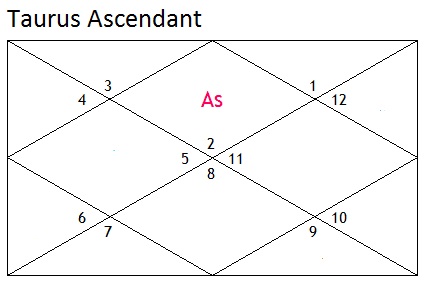
    Always see the sign rising in lagna first. The personality, physique, nature of a person will resemble that sign.

    It is also the First House: First House represents Self, physical body, health, longevity, head, hair, brain.

    taurus-ascendant

    For e.g. If Taurus is rising in lagna then immediately think of qualities of a Taurus and those characteristics will be present in the person.

    For learning the characteristics of any sign remember its image. Like Taurus is a Bull.

    taurus_bronze

    The person will be strongly built, will be full of energy, they are patient and steady, bulls are difficult to control once you provoke them but are mostly peaceful.

    It is ruled by Venus so they love beauty, luxury and have refined taste.

    Taurus is second sign of natural zodiac therefore they are materialistic and like to accumulate.

    It is an earthy sign therefore making them practical.

    It is a fixed sign making them rigid, and stubborn like a bull. They dislike change.

    Like this you combine Sign and House characteristics for each house.

    1. Planet placed in the First House


    After studying the sign check the planets placed in the lagna/first house. The person will majorly take on the characteristics of the planet placed.

    For e.g. In Taurus lagna, if Moon is placed in the ascendant i.e.  first house. The person will have a cool temperament, will be good looking, will be creative, love music and art.

    Combine characteristics of Moon and First House

    Now Moon is in its exaltation sign, so all the good characteristics of Moon will be present in full effect.

    Moon is the Third Lord for Taurus ascendant so he will be hardworking, will rise by self-efforts, courageous etc.

    1. Now check what planets aspect Lagna/First House

    See what planets aspect lagna, are they malefic or benefic and what lordships they have. It will influence the first house of a person to that effect.

    1. Lagna Lord/ First House Lord


    Only after checking all above parameters come to lagna lord i.e. Venus in this case.

    Check where venus is placed, how is its strength in rasi chart and navamsa chart and concur accordingly. Then check the aspects on Venus and planets conjunct with venus.

    For e.g. Venus is in Pisces that is its exaltation sign. Venus will be in 11th house of gains. The person will like to accumulate and will be born in a rich family and will have all the luxuries in life.


    1. Check the above planets strength in Navamsa Chart.
    2. Significactor/Karaka of first house: Sun

    Always see the condition/strength of the significator a particular house, in this case SUN to come to a conclusion about health.


     Similarly, check all other houses and have a basic idea in the back of your mind about each house and planet.


    Now this was only the Static Promise, for timing and dynamic analysis see the dasha.

    See what dasha the person is running and those results will be experienced according to planet’s strength and placement.


    Last check the Transit. See which houses the slow moving planets aspect to come to a conclusion.


    Let’s see an example to understand this:

    sj


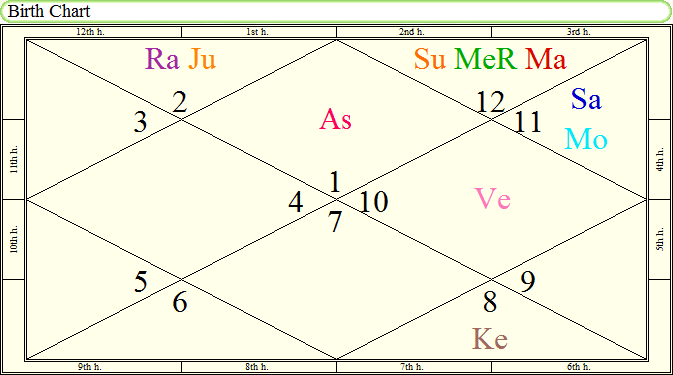
    This is a female chart. Born in 1966.

    Aries rising: Energetic, active, full of energy.

    No planet is placed in lagna/ first house.

    Saturn aspects lagna: Saturn is a natural malefic and in this case functional malefic as well. Therefore, it afflicts lagna/ first house. The person will have health issues especially in the dasha of Saturn.

    Lagna Lord: Mars in twelfth House in a friendly sign but a trik/bad house. Again, indicator of weak health.

    Mars is conjunct with Sun and Mer(R).

    Sun is the fifth lord. Rajayoga in twelfth House i.e. 5th and Lagna Lord combination. But it is an adverse house.

    Mercury is the 3rd and 6th lord (functional malefic) debilited in twelfth house. Now, lagna lord is conjunct with 6th lord again indicating health troubles related to nerves, skin since mercury represents those significations.

    Mars is also 8th lord. 6th 8th lords conjunction will give chronic disease.

    sjd9

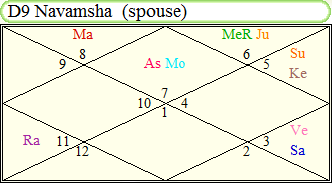
    Now in Navamsha Mars moves to scorpio which is its own sign but eighth house of horoscope showing some long lasting disease to body.

    Mercury goes to virgo in navamsha which is its exaltation sign, showing Mercury is strong and has inherent strength of giving diseases.

    She is always ill and frequently gets hospitalized. It has been a tendency throughout her life since her lagna lord is in twelfth and conjunct with 6th lord.

    Other things to consider:

    Budh Aditya Yoga

    Gajakesari Yoga

    Vipareeta Rajyoga

    Amala Yoga

    Similarly, check all other houses and see then see the dasha and transit and predict.

  • Moon and Astrology

    Moon and Astrology

    Moon is the most important planet in Vedic Astrology. It is the seed of a horoscope. Moon represents the mind of a person, his subconscious,his mental inclinations; the reason why the moon chart is so important in astrology. Many a times the results come out more correctly from Moon chart rather than the Ascendant.

    Persons dominated by a strong moon are dreamers, they are controlled by imagination,they are very creative and do not like the materialistic aspect of nature. They love Beauty and try to see the positive side of everything which also makes them very sensitive and caring. Travel is one thing which people with strong moon love to do, they seldom stay at one place. They are the one who build air castles, plan great things but seldom put them into operation because they have little practical value. Their world is full of imagination, they are very lazy and prefer to live in the dreamworld. They are restless and do not stay at one place because of which they love to travel.  In the charts of musicians, singers, writers, travelers Moon is strong.

    These people are driven by emotions, they are not practical which makes them romantic and loyal partners.

    They have a strong bond with their Mother as Moon represents mother in one’s chart. The various aspects on moon along with the Fourth House tells one about the bonding they with their mother and the also well being of the mother.

    Moon’s placement in various Houses further effects those houses in a lunar way and enhances the significations if the moon is well placed and well aspected.

    Let’s consider Moon in Seventh House,

    Seventh house is he house of romance, marital happiness, partnerships, foreign among many other things.

    When strong moon is placed in the seventh house, the native gets a beautiful and charming partner. He is compassionate, gets easily influenced by the opposite sex, desires to live in a foreign country. Gains from foreign trade, water products, loves to travel.

    Moon decides the dasha balance one gets in life which times all the events that takes place in life. It travels the entire zodiac in 28 days.

  • The Science Behind Jyotisha: Astrology Meets Astronomy

    The Science Behind Jyotisha: Astrology Meets Astronomy

    Jyotisha: The Ancient Science of Vedic Astrology

    Jyotisha, or Vedic Astrology, has been a cornerstone of Indian wisdom for thousands of years. As one of the six Vedangas (limbs of the Vedas), it represents a holistic blend of astronomy, philosophy, and spirituality. Jyotisha studies planetary movements and their influence on life from a geocentric perspective, Earth’s point of view. Remarkably, the astronomical calculations of planetary distances, movements, and sizes documented in ancient texts align closely with modern scientific standards.

    This profound science serves as a tool to study time’s impact on individuals, societies, and nations. Rooted in the principles of karma and reincarnation, Jyotisha aims to guide individuals toward spiritual growth and holistic upliftment. Its essence lies not merely in prediction but in aiding self-awareness and aligning one’s life with cosmic rhythms.

    The relationship between the grahas (planets) and human life might seem enigmatic, yet it underscores a deep interplay between the universe and individual existence. The microcosm-macrocosm analogy sheds light on this interconnection, suggesting that the patterns in the cosmos mirror those within us.

    At a philosophical level, Jyotisha invites us to explore profound questions about destiny and free will. If life events are preordained, what role does free will play in shaping our journey? This paradox continues to intrigue seekers and scholars, bridging the realms of science, spirituality, and human inquiry.

    The stars impel, they do not compel. Let’s find your path.